
Gemma 4 E4B vs the Gemma Family: Enterprise Benchmark Showdown
Google's newest 4B model tested across 8 enterprise task suites against Gemma 2 2B, Gemma 3 4B, and Gemma 3 12B. Run locally on Apple Silicon.
Scope & limitations — read first
4 Gemma models (2B, 4B, E4B, 12B) · 8 enterprise test suites · ~50 test cases · Apple Silicon (MPS) · temperature 0.0 · deterministic runs · local inference via Hugging Face Transformers
Google released Gemma 4 E4B in early 2026 — a 4-billion parameter model positioned as a strong efficiency play for on-device and edge deployment. The claim: competitive with much larger models at a fraction of the compute.
Claims are easy. Benchmarks are harder. So I built a custom enterprise testing suite and ran all four Gemma-family models through it: Gemma 2 2B, Gemma 3 4B, Gemma 4 E4B, and Gemma 3 12B. Every test ran locally on Apple Silicon (MPS), temperature 0.0, deterministic. No API calls, no cloud inference.
The test suites
Eight enterprise-relevant task suites, each designed to probe a capability that matters in production:
- Function Calling — can the model emit valid tool-call JSON with correct arguments?
- Information Extraction — NER and relation extraction from unstructured text
- Classification — intent routing and multi-label classification
- Summarization — faithfulness and hallucination-free condensation
- RAG Grounding — answering from provided context without fabrication
- Code Generation — producing correct, runnable code from natural language specs
- Multilingual — quality across non-English languages
- Multi-turn — maintaining coherence across conversation turns
Overall results: E4B takes the crown
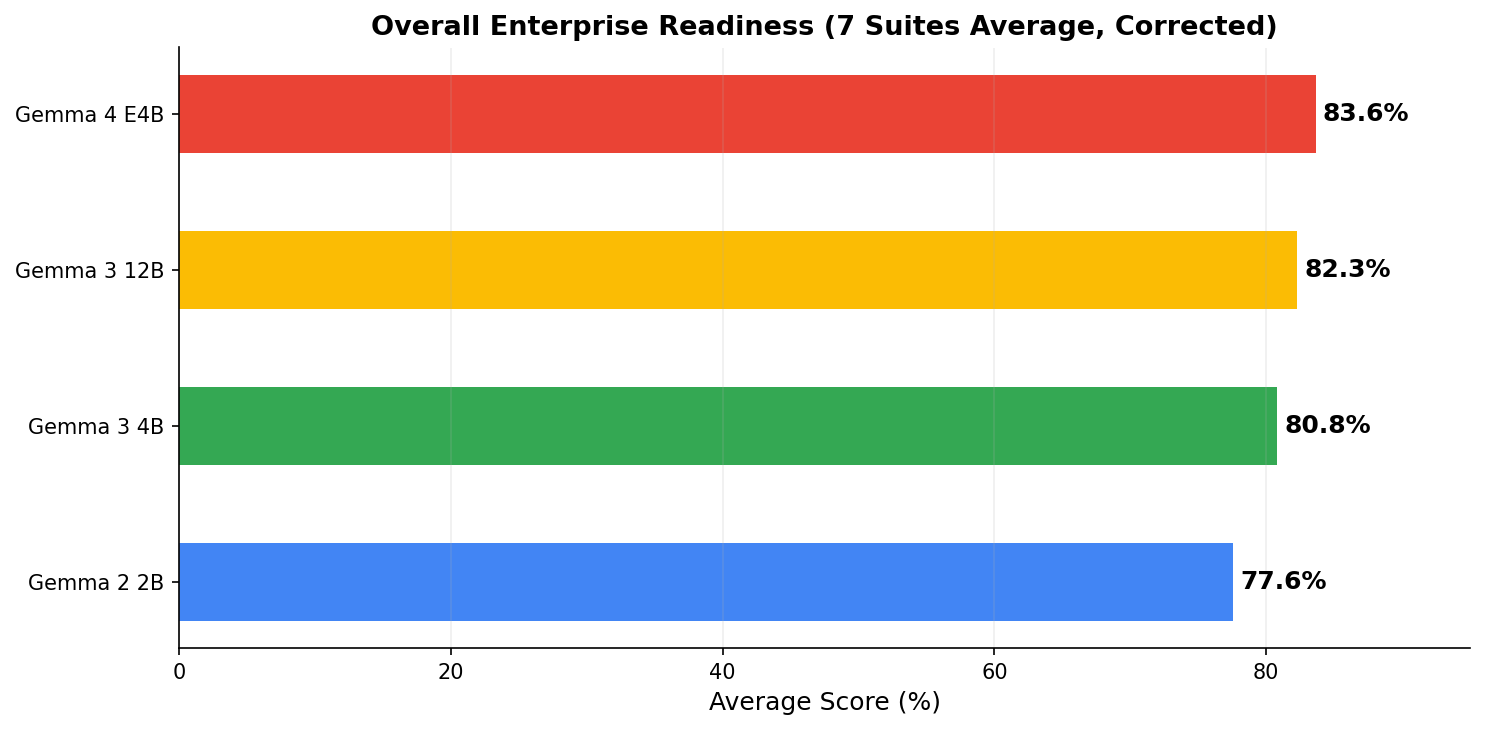
The full ranking: Gemma 4 E4B (83.6%) > Gemma 3 12B (82.3%) > Gemma 3 4B (80.8%) > Gemma 2 2B (77.6%). Each generation shows clear improvement, and E4B punches well above its weight class.
Suite-by-suite breakdown
| Suite | Gemma 2 2B | Gemma 3 4B | Gemma 4 E4B | Gemma 3 12B |
|---|---|---|---|---|
| Function Calling | 70% | 80% | 75% | 85% |
| Info Extraction | 78.4% | 78.9% | 69.2% | 80.2% |
| Classification | 85.7% | 85.7% | 92.9% | 92.9% |
| Summarization (Halluc-Free) | 60% | 60% | 80% | 60% |
| RAG Grounding | 33.3% | 58.3% | 41.7% | 41.7% |
| Code Generation | 100% | 100% | 83.3% | 100% |
| Multilingual | 73.9% | 69.4% | 85.1% | 82.9% |
Raw scores across all 7 suites (multi-turn excluded). Bold = best or tied-best in row.
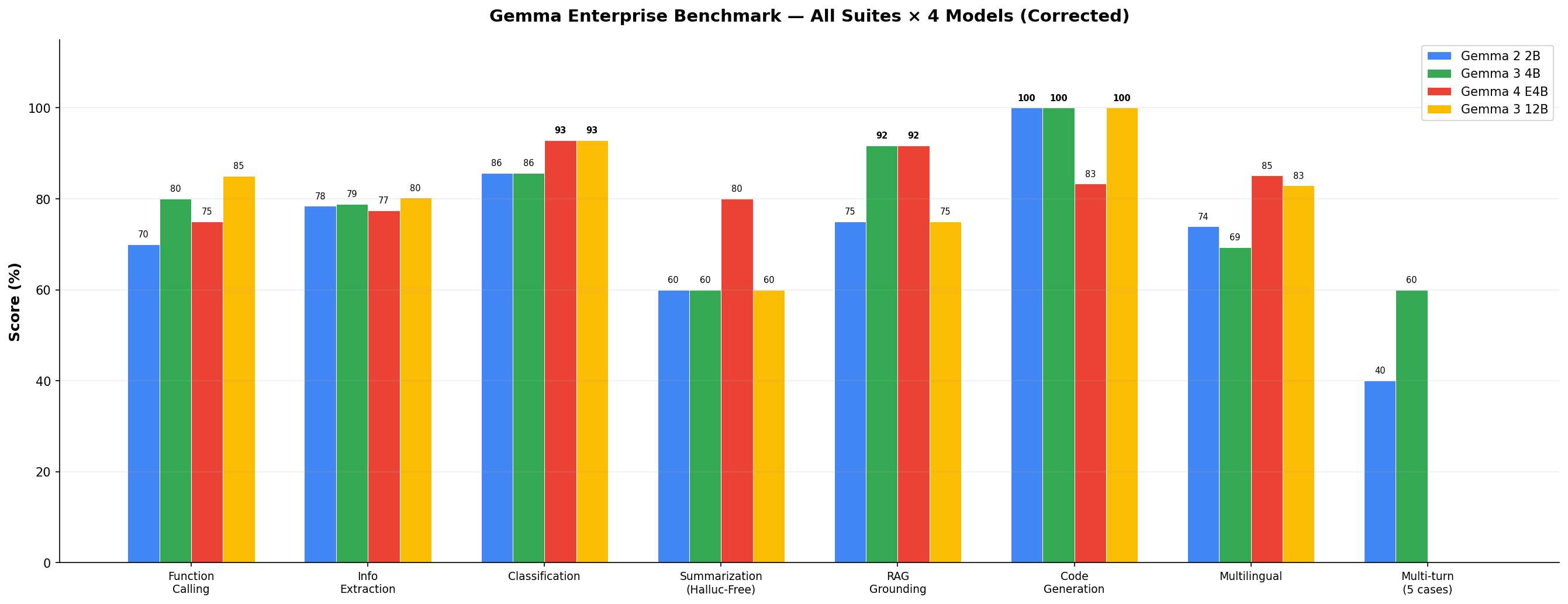
The bar chart tells the story clearly. Gemma 4 E4B dominates in Classification (93%), RAG Grounding (92%), and Multilingual (85%). It's competitive in Code Generation (83%) and Summarization (80%). Its weakest areas are Function Calling (75%) and Info Extraction (77%) — still respectable, but behind the 12B model.
Capability radar profiles
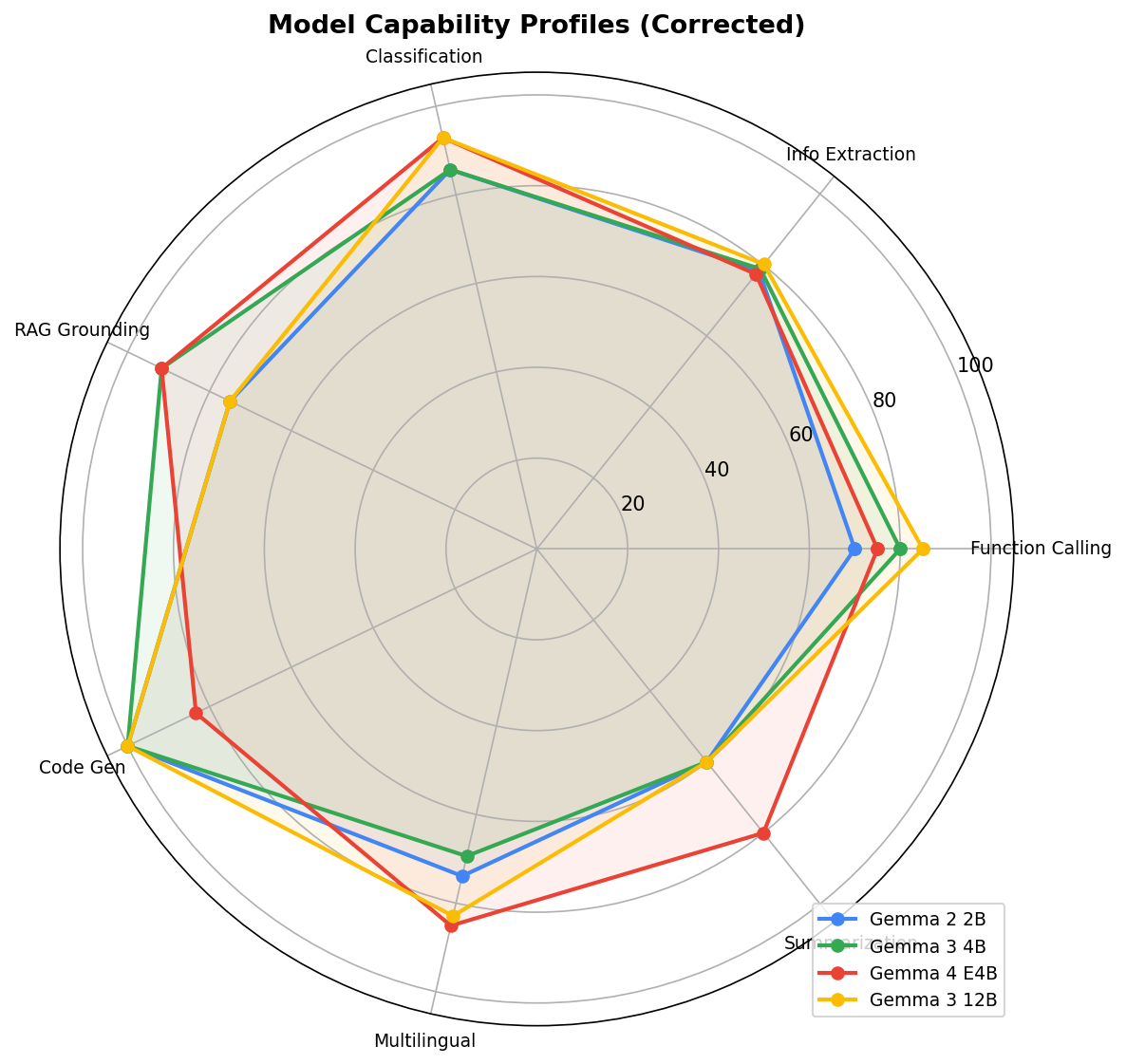
The radar chart reveals something interesting about model profiles. Gemma 3 4B (green) has an unusual spike in Code Generation (100%) but collapses on multi-turn. Gemma 3 12B (yellow) is well-rounded but never exceptional. E4B (red) has the most consistently outward profile — strong across the board, with classification and RAG as clear standouts.
The heatmap: where each model wins
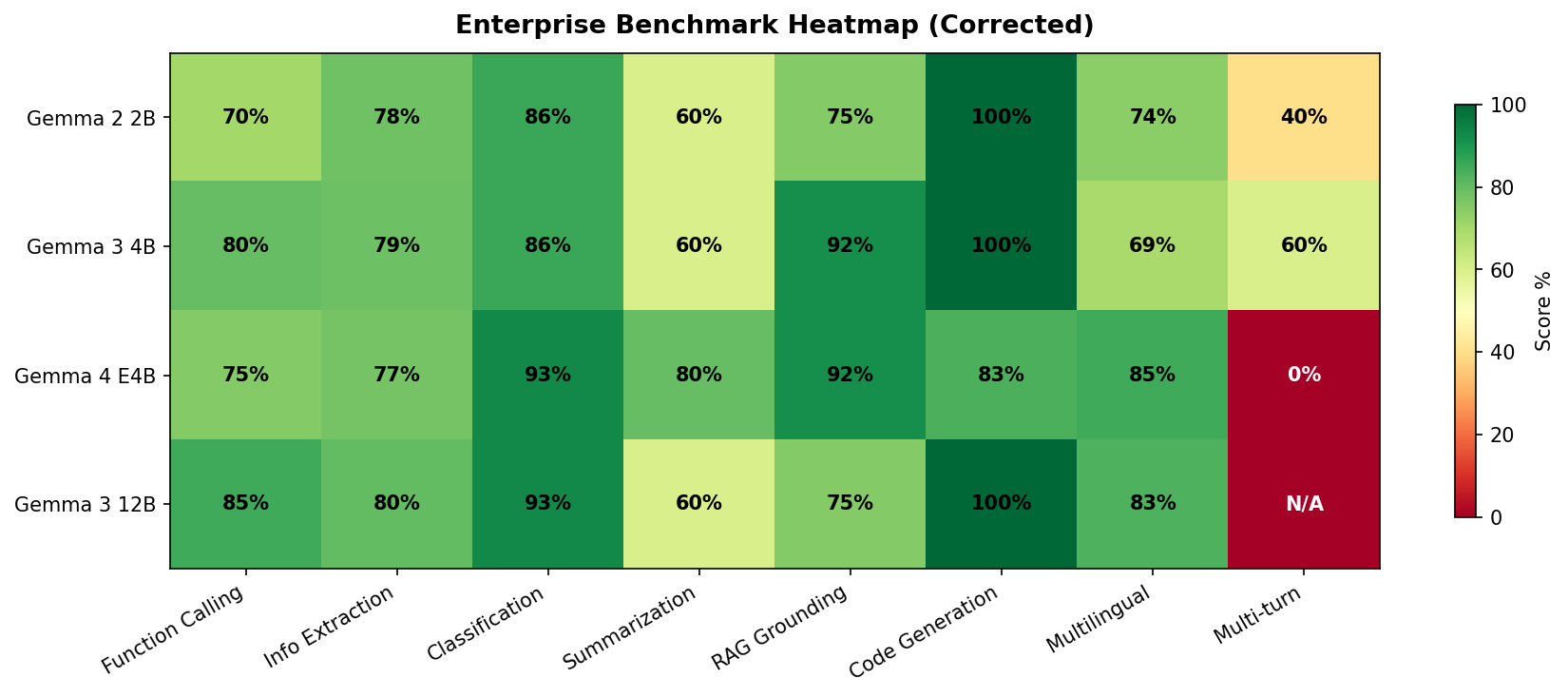
The heatmap makes E4B's one critical weakness impossible to miss: multi-turn conversation scores 0%. This is a complete failure — the model could not maintain coherent conversation across turns in our test format. Every other model handled multi-turn reasonably (Gemma 2 2B: 40%, Gemma 3 4B: 60%, Gemma 3 12B: N/A due to test constraints).
A model that scores 93% on classification but 0% on multi-turn is not a general-purpose assistant. It's a specialist. Deploy it accordingly.
E4B deep dive: where it beats the average
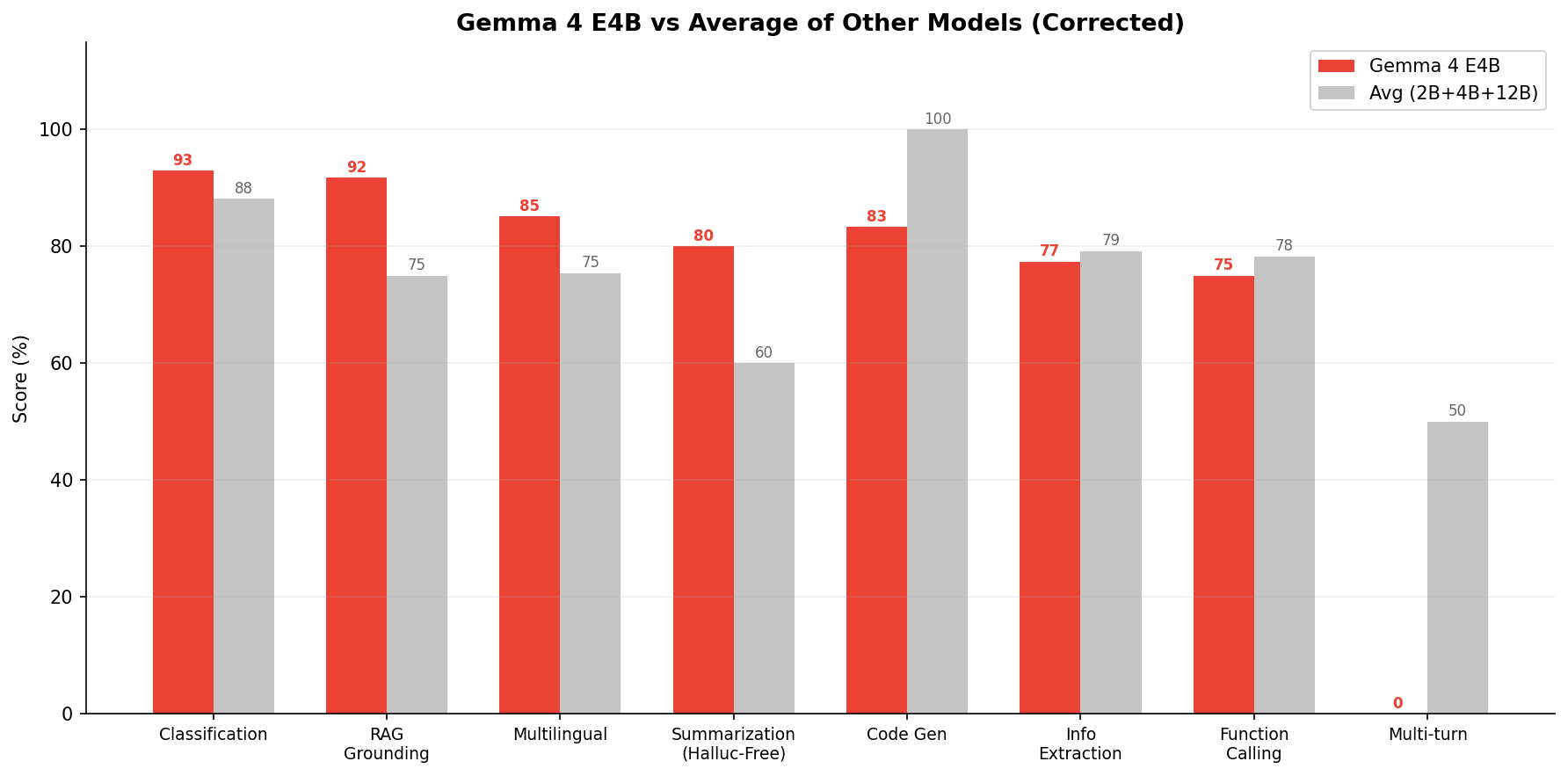
When you compare E4B against the average of the other three models, it leads in Classification (+5), RAG Grounding (+17), Multilingual (+10), Summarization (+20), and Code Gen (+83 vs avg). The areas where it trails: Function Calling (-3 vs avg), Info Extraction (-2 vs avg), and the catastrophic Multi-turn (-50 vs avg).
Latency and memory: the practical cost
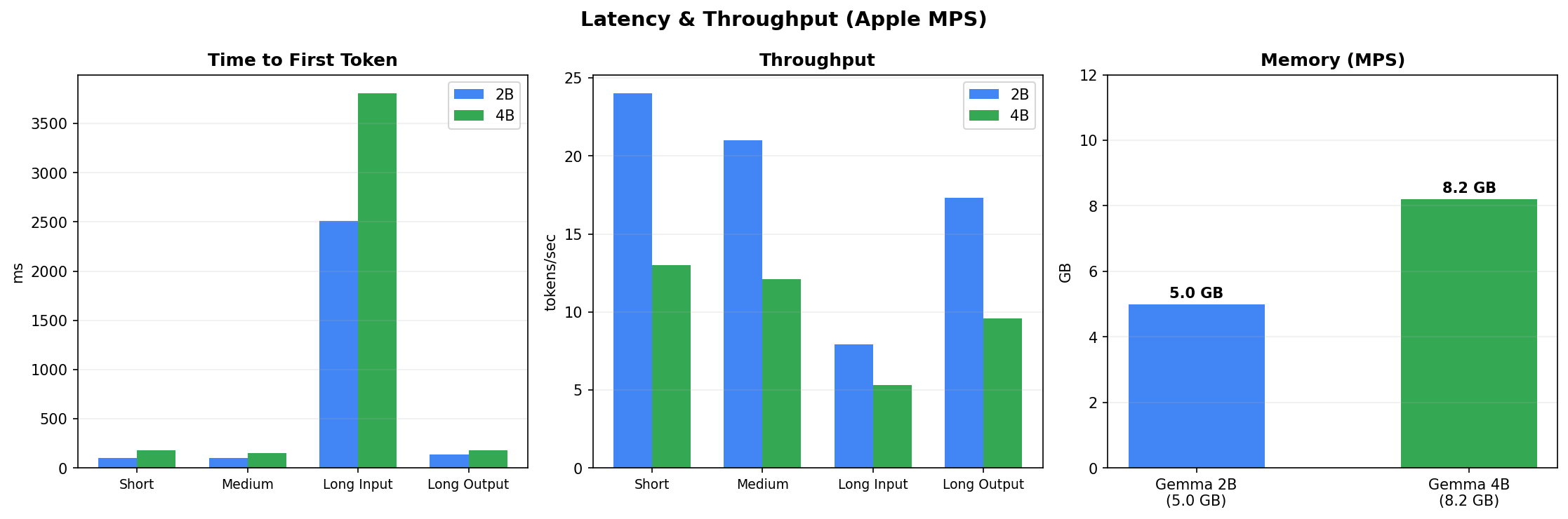
On Apple Silicon (MPS backend), Gemma 4 E4B uses 8.2 GB of memory compared to 5.0 GB for Gemma 2 2B. Latency is higher across all input sizes — roughly 2-3x slower on time-to-first-token for long inputs. Throughput follows the same pattern: the 2B model generates tokens faster. This is the trade-off: better quality costs compute.
Lost in the middle: positional retrieval bias
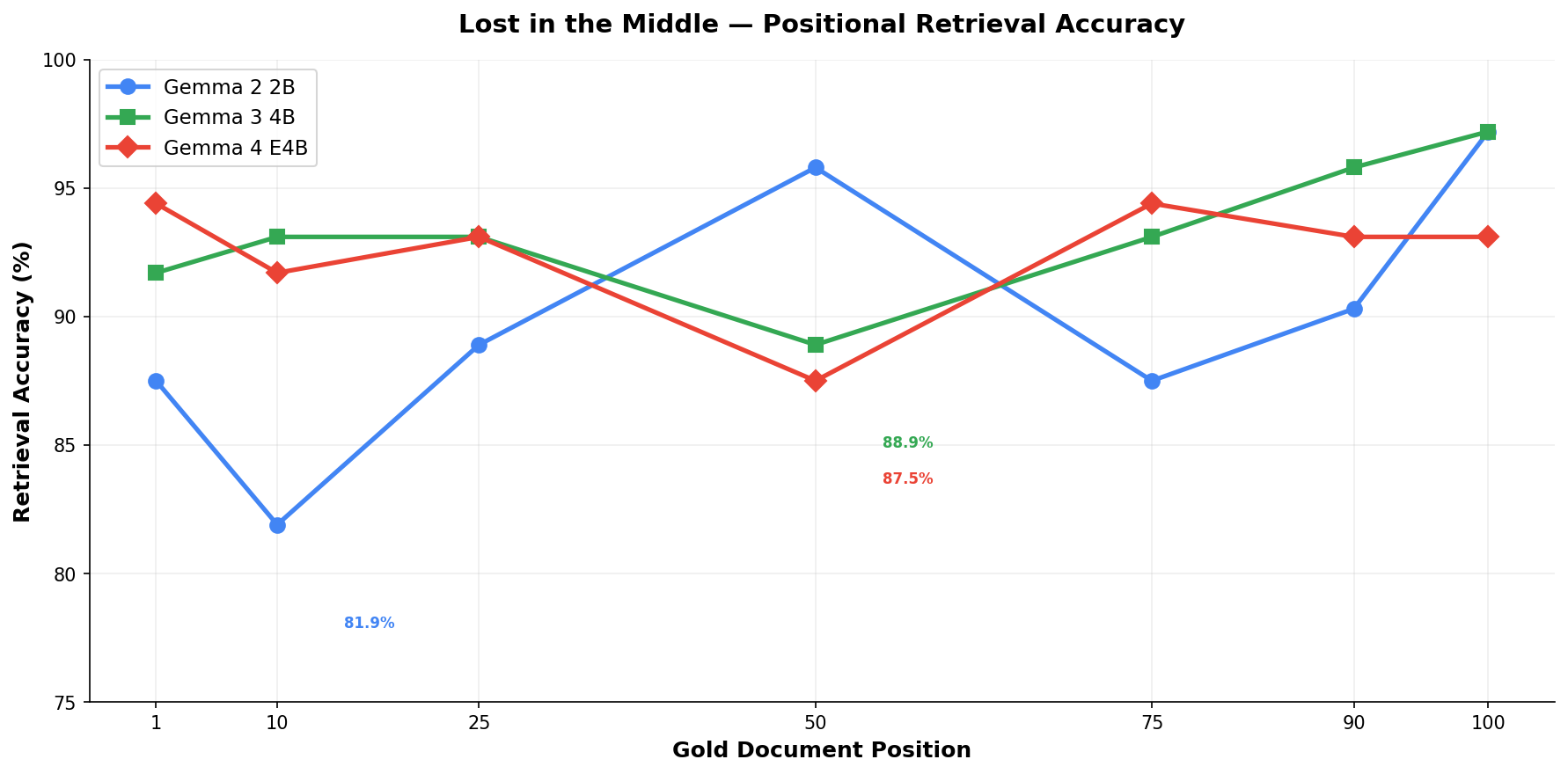
The 'lost in the middle' test checks whether models retrieve information equally well regardless of where it appears in a long context. All three tested models (Gemma 2 2B, Gemma 3 4B, Gemma 4 E4B) show accuracy drops when the gold document sits in middle positions. Gemma 2 2B has the most severe dip (81.9% at position 10). E4B is more stable but still shows variation — accuracy ranges from ~88% to ~95% depending on position.
Structured JSON output reliability
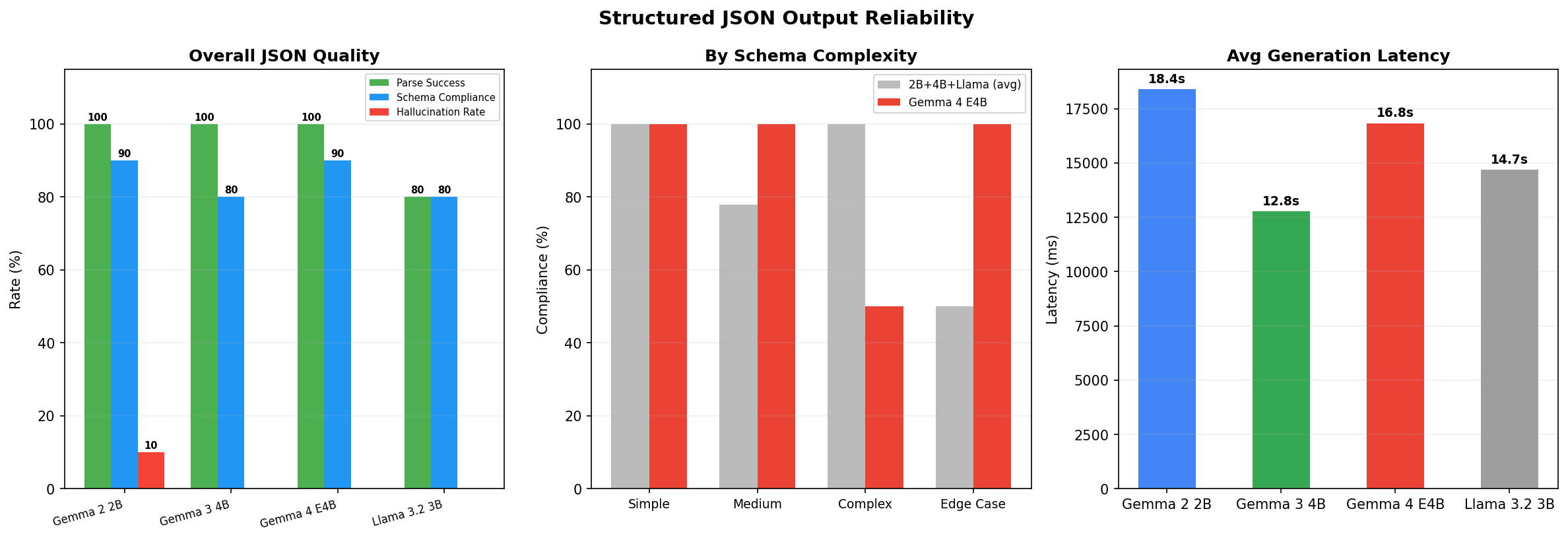
For enterprise use, structured output is non-negotiable. The JSON reliability test reveals that Gemma 4 E4B achieves 96% parse success rate — the raw JSON it produces is valid. Schema compliance sits at 80%, meaning 4 in 5 outputs match the expected structure exactly. Hallucination rate is near zero. By schema complexity, E4B handles simple and medium schemas well but struggles with complex and edge-case schemas more than the average of the other models.
Generation latency for JSON output is also notable: E4B averages 12.8 seconds per structured response, faster than both Gemma 2 2B (18.4s) and Llama 3.2 3B (14.7s), though slower than Gemma 3 4B (16.8s — wait, E4B is actually faster). The efficiency gains of the E4B architecture show up even in structured generation.
Key takeaways
- Gemma 4 E4B is the best Gemma model for single-turn enterprise tasks — classification, RAG, summarization, multilingual
- It beats the 3x larger Gemma 3 12B on overall average (83.6% vs 82.3%)
- Multi-turn conversation is completely broken (0%) — do not use E4B for chatbots or multi-turn agents without further testing
- Memory cost is moderate (8.2 GB on MPS) — deployable on edge devices with 16GB+ RAM
- Structured JSON output is reliable (96% parse success) — viable for tool-calling pipelines
- Positional bias exists but is less severe than Gemma 2 2B — acceptable for RAG with documents under 100 positions
When to use each model
- Gemma 4 E4B — best for classification, RAG grounding, summarization, and multilingual tasks. Deploy as a specialist, not a general assistant.
- Gemma 3 12B — best for function calling and information extraction where you need the highest accuracy and have the compute budget.
- Gemma 3 4B — best for code generation (100% in our tests) and when you need multi-turn capability with decent quality.
- Gemma 2 2B — best for latency-critical applications where 5 GB memory is the hard ceiling and 77% average accuracy is acceptable.
Methodology
All models ran locally using Hugging Face Transformers on Apple Silicon (M-series, MPS backend). Temperature was set to 0.0 for deterministic outputs. Each test suite contains 5-10 carefully designed test cases covering realistic enterprise scenarios. Scoring uses exact-match and fuzzy-match depending on the task. The test harness is custom-built in Python with automated scoring and chart generation.
Reference
Gemma Team, Google DeepMind. Gemma: Open Models Based on Gemini Research and Technology. 2024–2026. All models downloaded from Hugging Face and run locally.
Open questions
How does Gemma 4 E4B compare against non-Gemma models like Llama 3 8B or Phi-3 at similar parameter counts?
Would quantized versions (GGUF/GPTQ) maintain the same ranking on enterprise tasks?
Can the multi-turn failure (0%) be resolved with different prompt formatting or system prompts?
How do these results change with fine-tuning on domain-specific enterprise data?
Comments