
Why Every AI Integration Fails Without a Governed API Layer
95% of enterprise AI pilots fail. Everyone blames the model. The model is fine.
Scope & limitations — read first
Enterprise AI integration · API governance · MCP versioning · Data sourced from MIT Sloan, McKinsey, Treblle (1B API requests)
When an AI project fails in production, the post-mortem points at the model. Wrong prompt. Wrong temperature. Wrong model. So the team swaps the model. The demo looks great again. Then it fails again in production.
The model was never the problem.
The numbers
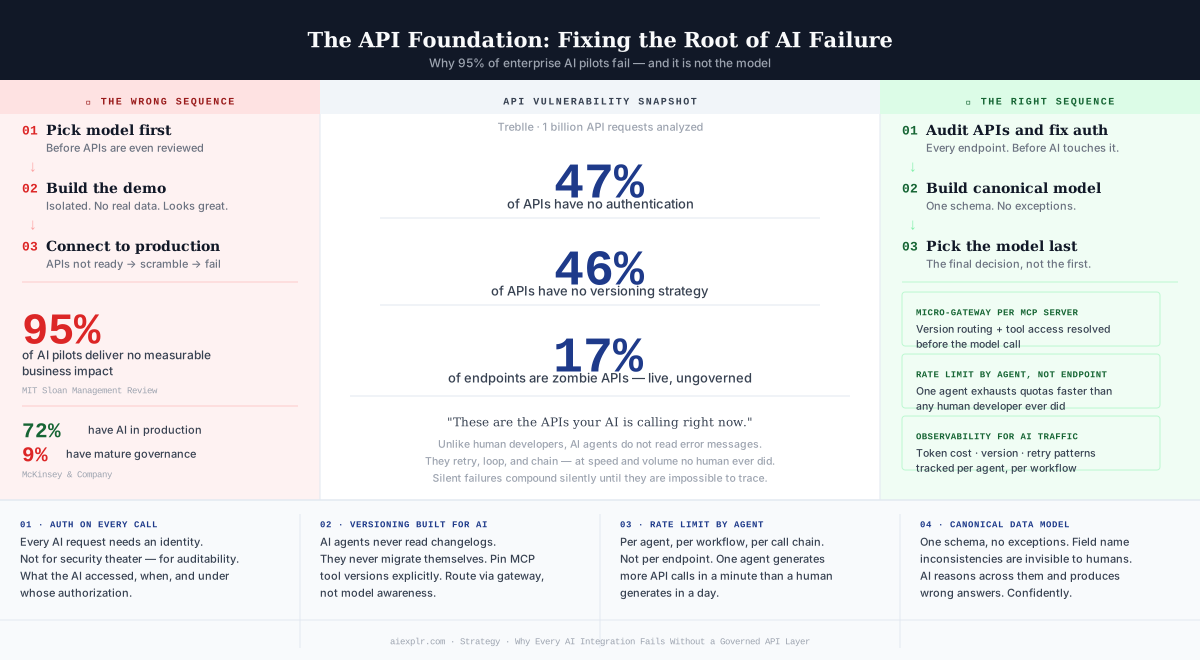
MIT studied enterprise AI pilots. 95% delivered no measurable business impact. Not spectacular failures — quiet ones. The cause wasn't model capability. It was integration gaps, data problems, and governance gaps.
McKinsey: 72% of enterprises have AI in production. Only 9% have mature governance. That gap is where failures live.
Treblle analyzed a billion API requests:
| What they found | How bad |
|---|---|
| No authentication | 47% of APIs |
| No versioning strategy | 46% of APIs |
| Zombie APIs — live, ungoverned | 17% of endpoints |
Source: Treblle · 1 billion API requests analyzed
These are not legacy systems nobody uses. These are the APIs your AI is calling right now.
What happens when AI hits an ungoverned API
An AI agent doesn't call an API once. It calls in loops. It retries. It chains. At speed and volume no human ever did.
- No versioning → Breaking change returns malformed data silently. AI produces a confident wrong answer. Nobody knows why.
- No authentication → No audit trail. In regulated industries that's not a governance problem. That's a compliance violation.
- No rate limiting → Model stuck in a retry loop. Quota exhausted in minutes. Token bill spikes instantly and silently.
- Inconsistent schema → Same endpoint, different field names. AI doesn't throw an error. It reasons across the inconsistency and gets it wrong. Confidently.
Every single one of these is a silent failure.
Why human API governance doesn't transfer to AI
Human API consumers are forgiving. A developer hits a malformed response and reads the error. They check the docs. They file a ticket. They wait for the fix.
AI agents are not forgiving. They move faster than any human feedback loop. By the time you notice something is wrong, the agent has already made ten thousand calls, processed ten thousand bad responses, and produced ten thousand outputs that look correct. The API layer that was good enough for human developers is not good enough for AI.
The versioning problem nobody is talking about
API versioning has always been hard. When you change an API, you maintain the old version long enough for every consumer to migrate. Annoying, but solvable — because human consumers are aware.
A human developer knows which version they're on. Gets the deprecation email. Reads the changelog. Migrates on a schedule.
An AI agent calls what it was configured to call. Has no awareness v2 exists. Has no mechanism to discover v1 is deprecated. Keeps calling v1 confidently until v1 disappears. Everything breaks at once.
It gets worse inside MCP. When an MCP server gets updated — new tool definitions, new schema, new endpoint — the model doesn't know. It was configured against the old description. The tool changed underneath it. No error. No warning. Just drift.
And the model cannot decide which version to use per consumer. If Agent A needs v1 and Agent B needs v2, that routing decision cannot happen at the model. It cannot happen at the MCP server either. Both agents call the same tool name. The tool name is identical. The model sees no difference. This is not a model problem. This is a governance problem.
But a single gateway isn't enough either
The standard answer is: put a gateway in front. Route by caller identity. Send Agent A to v1, Agent B to v2. But that raises an immediate question. How does the gateway know which agent gets which version? How does it know which tools each agent is even allowed to call? A single monolithic gateway knowing the version contract and tool access list for every agent in the enterprise is a configuration nightmare. It doesn't scale. It becomes a bottleneck. The answer is a micro-gateway per MCP server.
The micro-gateway architecture
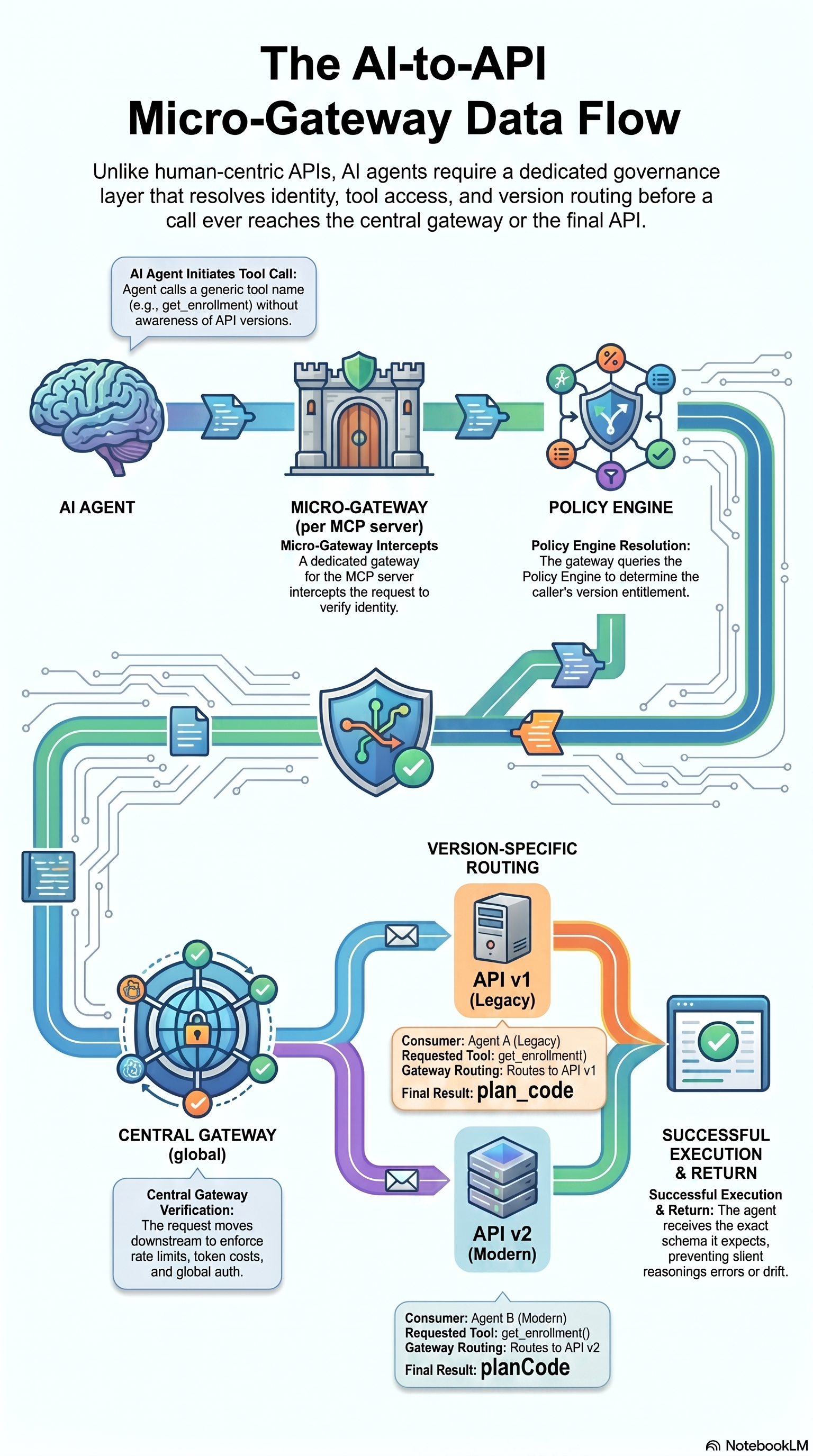
Each MCP server gets its own micro-gateway. The micro-gateway sits in front — between the agent and the central gateway downstream.
Micro-gateway — one per MCP server, not one per agent. The MCP server is already the natural boundary for tool ownership. The micro-gateway wraps that boundary with identity and policy. When an agent calls a tool, the micro-gateway asks the policy engine: who is this caller, what version are they entitled to, which tools are they allowed to use?
Policy engine — the single source of truth. It holds the mapping: Agent A gets v1, tools x and y. Agent B gets v2, tools x, y, and z. Update the policy engine once — every micro-gateway reflects it automatically. The micro-gateway gets the answer, asserts the identity downstream, and passes the call to the central gateway with the version contract attached.
Central gateway — downstream from every micro-gateway. It doesn't need to know which agent is which or which version they need. The micro-gateway already resolved that. The central gateway enforces the things that apply to every call: rate limiting, token cost control, authentication, observability.
The model never knows any of this happened. It called a tool. The governance layer handled everything else.
What this solves
- Version routing without model awareness — Agent A and Agent B call the same tool name. They get different API versions. Neither knows the other exists.
- Tool access control per agent — The policy engine decides which tools each agent can call. A new agent gets exactly what its policy allows, not everything by default.
- Safe deprecation — Before retiring v1, the central gateway's observability tells you which agents are still calling it. You don't deprecate until that list is empty.
- Single source of truth — Version mappings and tool access lists live in the policy engine. One update propagates everywhere. No per-gateway configuration drift.
- MCP server updates don't break agents — When a tool definition changes, the micro-gateway catches the version mismatch before it reaches the agent.
The five things you still need
The micro-gateway architecture handles versioning and access control. But it sits on top of a governed API layer that needs these five things regardless.
1. Versioning with a backward compatibility commitment
Not the versioning you built for human developers. A contract that accounts for consumers who will never read a changelog and cannot migrate themselves.
2. Authentication on every call
Every AI request needs an identity. Not for security theater — for auditability. What did the AI access. When. Under whose authorization.
3. Rate limiting with token cost awareness
Per agent. Per workflow. Per consumer. Not just per endpoint. One agent workflow can generate more calls in a minute than a human generates in a day.
4. A canonical data model
Inconsistent schemas are invisible to humans who know the domain. They are catastrophic for AI. One model. One schema. No exceptions. This is the hardest thing to build and the most important to get right.
5. Observability built for AI traffic
Response times and error rates are not enough. You need token cost by agent. Version by consumer. Retry patterns by workflow. Which agents are still on deprecated versions. If you can't see it you can't govern it.
The sequence that works
The model is the last decision. Not the first.
What's coming
Gartner projects 40% of enterprise applications will embed AI agents by end of 2026. Up from less than 5% today. Most of those enterprises have APIs built for human consumption. Never audited for AI readiness. Governed by policies that predate the concept of an AI consumer.
The enterprises getting AI into production aren't the ones with the best models. They're the ones who built the foundation first.
The model isn't the bottleneck. It never was. The API layer is. Build that first.
Open questions
At what org size does the micro-gateway pattern become worth the overhead?
How do you handle MCP servers owned by third parties — you can't wrap them in your gateway?
What does mature AI API governance actually look like at a company that has it right?
Comments